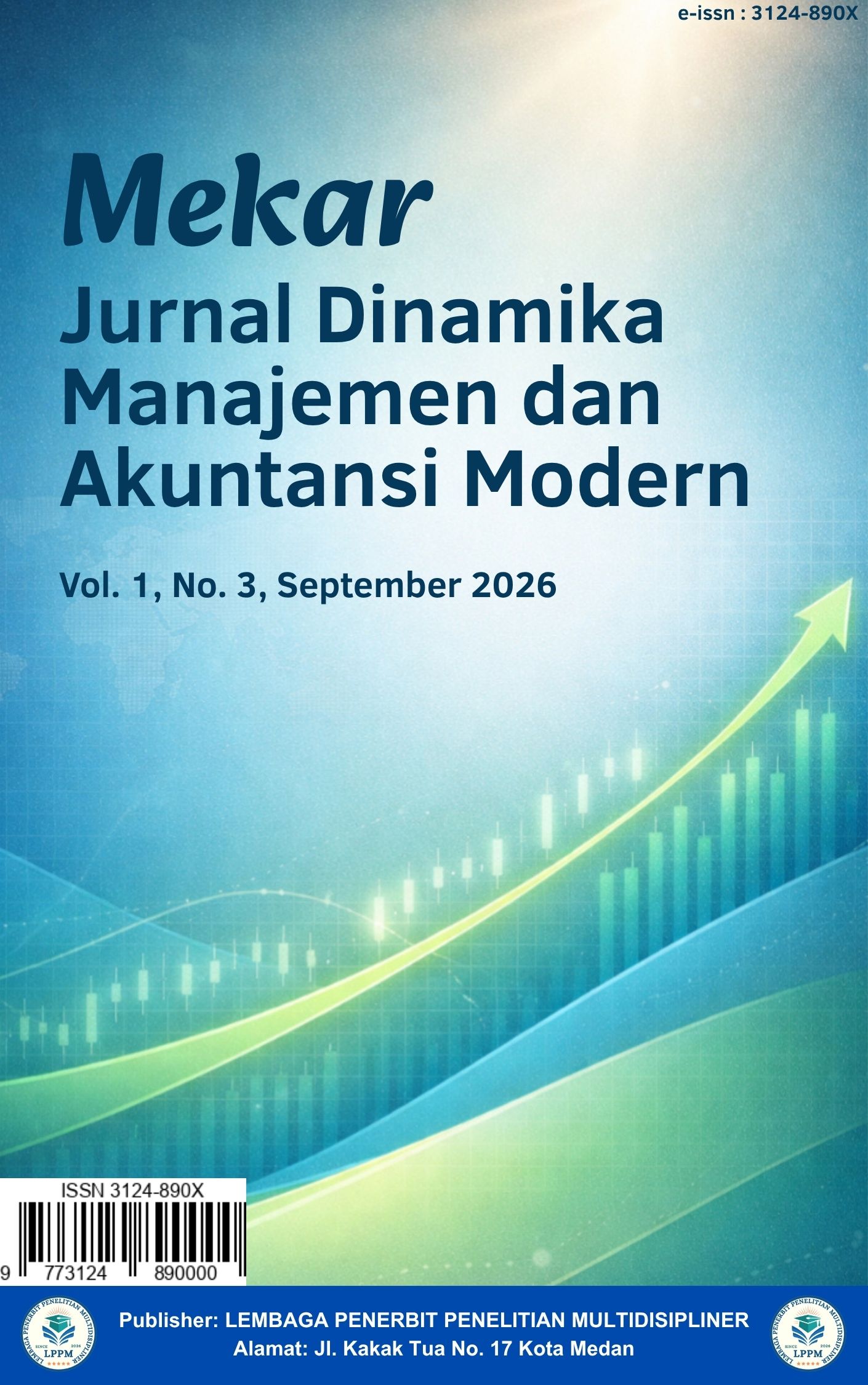
Peran Fintech Syariah dalam Memperluas Akses Pembiayaan UMKM: Studi Multi-Kasus Pada Platform Peer-To-Peer Lending di Indonesia
DOI:
https://doi.org/10.67096/mekar.v1i3.411Keywords:
fintech syariah, UMKM, peer-to-peer lending, LPBBTI, inklusi keuangan, pembiayaan syariahAbstract
Penelitian ini menganalisis peran fintech syariah berbasis peer-to-peer lending dalam terminologi regulasi yang disebut Layanan Pendanaan Bersama Berbasis Teknologi Informasi (LPBBTI) dalam memperluas akses pembiayaan UMKM di Indonesia. Penelitian menggunakan desain studi multi-kasus pada tiga platform syariah, yaitu ALAMI, Ammana, dan Ethis Indonesia. Analisis dilakukan melalui pengodean tematik, pencocokan pola, dan sintesis lintas kasus. Temuan menunjukkan bahwa digitalisasi proses, penggunaan data alternatif dalam penilaian kelayakan, dan fleksibilitas akad memperluas akses bagi UMKM yang sebelumnya sulit memperoleh pembiayaan bank. Sebanyak 22 dari 30 UMKM pernah mengalami penolakan pembiayaan bank, sedangkan 23 UMKM menilai mekanisme bagi hasil membantu pengelolaan arus kas. Perbandingan deskriptif setelah 12 bulan menunjukkan kenaikan omzet, modal kerja, tenaga kerja, kapasitas produksi, dan perluasan pasar; namun, hasil tersebut tidak ditafsirkan sebagai hubungan kausal. Efektivitas layanan ditentukan oleh kualitas credit scoring, pengawasan syariah, pendampingan usaha, tata kelola risiko, dan dukungan regulasi. Tantangan utama meliputi pembiayaan bermasalah, literasi keuangan dan digital yang belum merata, kesenjangan infrastruktur, serta keamanan data.
References
Alsaghir, M. (2023). Digital risks and Islamic FinTech: A road map to social justice and financial inclusion. Journal of Islamic Accounting and Business Research. https://doi.org/10.1108/JIABR-10-2022-0262
Chong, F. H. L. (2021). Enhancing trust through digital Islamic finance and blockchain technology. Qualitative Research in Financial Markets, 13(3), 328–341. https://doi.org/10.1108/QRFM-05-2020-0076
Edward, M. Y., Fuad, E. N., Ismanto, H., Atahau, A. D. R., & Robiyanto. (2023). Success factors for peer-to-peer lending for SMEs: Evidence from Indonesia. Investment Management and Financial Innovations, 20(2), 16–25. https://doi.org/10.21511/imfi.20(2).2023.02
Farquhar, J., Farquhar, J., Michels, N., & Robson, J. (2020). Triangulation in industrial qualitative case study research: Widening the scope. Industrial Marketing Management, 87, 160–170. https://doi.org/10.1016/J.INDMARMAN.2020.02.001
Firmansyah, E. A., Masri, M., Anshari, M., & Besar, M. H. A. (2024). Factors influencing SME project returns on Islamic FinTech lending platform. Journal of Islamic Accounting and Business Research. https://doi.org/10.1108/JIABR-10-2023-0340
Ha, D., Le, P., & Nguyen, D. K. (2025). Financial inclusion and fintech: A state-of-the-art systematic literature review. Financial Innovation, 11(69). https://doi.org/10.1186/s40854-024-00741-0
Hudaefi, F. A. (2020). How does Islamic fintech promote the SDGs? Qualitative evidence from Indonesia. Qualitative Research in Financial Markets, 12(4), 353–366. https://doi.org/10.1108/QRFM-05-2019-0058
Hudaefi, F. A., Hassan, M. K., & Abduh, M. (2023). Exploring the development of Islamic fintech ecosystem in Indonesia: A text analytics. Qualitative Research in Financial Markets, 15(3), 514–533. https://doi.org/10.1108/QRFM-04-2022-0058
Keuangan, O. J. (2025). Statistik Layanan Pendanaan Bersama Berbasis Teknologi Informasi Desember 2024.
Kholidah, H., Fianto, B. A., Herianingrum, S., Ismail, S., & Mohd Hidzir, P. A. (2025). Do Islamic fintech lending promote microenterprises performance in Indonesia? Evidence of difference-in-difference model. International Journal of Islamic and Middle Eastern Finance and Management, 18(1), 224–246. https://doi.org/10.1108/IMEFM-08-2023-0310
Mahendra, G. A., Nurjaya, N., Alkhair, R., & Aminuddin, M. (2022). Sharia Financial Technology in the Distribution of People’s Business Credit Program Funds for Micro, Small, and Medium Enterprises. Devotion, 3(3), 270–283. https://doi.org/10.36418/dev.v3i3.120
Mahmoud, M. A., Ma’aji, M. M., Abdullahi, M. S., Karaye, A. B., & Garba, A. S. (2025). Factors influencing the Islamic Fintech acceptance: Moderating role of Islamic financial literacy. Journal of Islamic Accounting and Business Research. https://doi.org/10.1108/JIABR-08-2024-0322
Maniam, S. (2024). Determinants of Islamic fintech adoption: A systematic literature review. Journal of Islamic Marketing, 15(11), 2916–2936. https://doi.org/10.1108/JIMA-11-2023-0373
Masrizal, Sukmana, R., & Trianto, B. (2025). The effect of Islamic financial literacy on business performance with emphasis on the role of Islamic financial inclusion: Case study in Indonesia. Journal of Islamic Marketing, 16(1), 166–192. https://doi.org/10.1108/JIMA-07-2022-0197
Muryanto, Y. T. (2023). The urgency of Sharia compliance regulations for Islamic Fintechs: A comparative study of Indonesia, Malaysia and the United Kingdom. Journal of Financial Crime, 30(5), 1264–1278. https://doi.org/10.1108/JFC-05-2022-0099
Rabbani, M. R., Khan, S., & Atif, M. (2023). Machine learning-based P2P lending Islamic Fintech model for small and medium enterprises in Bahrain. International Journal of Business Innovation and Research, 30(4), 565–579. https://doi.org/10.1504/IJBIR.2023.130079
Rahayu, R., Ali, S., Hidayah, R., & Nabila, S. (2024). Determinant factors of Islamic financial technology acceptance: Evidence from Indonesia. Journal of Telecommunications and the Digital Economy, 12(1), 405–426. https://doi.org/10.18080/jtde.v12n1.790
Shaikh, I. M., Qureshi, M. A., Noordin, K., Shaikh, J. M., Khan, A., & Shahbaz, M. S. (2020). Acceptance of Islamic financial technology (FinTech) banking services by Malaysian users: An extension of Technology Acceptance Model. Foresight, 22(3), 367–383. https://doi.org/10.1108/FS-12-2019-0105
Tias, S. A. (2024). Teacher Reform in Indonesia: Perspectives Towards Teacher Professional Education Programme to Improve Teachers’ Competencies.
Utama, S. P., & Ilahiyah, I. (2018). Pengembangan Model Low Cost Islamic Peer To Peer Financing Berbasis Financial Technology Untuk Akselerasi Kinerja UMKM. 4(2), 249–276. https://doi.org/10.21111/IEJ.V4I2.2966
Yin, R. K. (2018). Case Study Research and Applications: Design and Methods (Vol. 11, Issue 1). Sage Publication, Inc.
Downloads
Published
How to Cite
Issue
Section
License
Copyright (c) 2026 Rangga Aprianto, Cut Yanti Nora, Abdul Kadir, Ardi Megantoro (Author)

This work is licensed under a Creative Commons Attribution-ShareAlike 4.0 International License.